


Your next customer may never open your app, scroll your homepage, or read a single product description. They’ll send an AI agent instead, and that agent will decide whether you exist based entirely on the quality of your data architecture.
Unfortunately, most Asian retailers aren’t ready for this, yet! Here’s how to find out if you are, and what to do about it.
The AI agent doesn’t browse. It queries. It doesn’t feel brand affinity. It parses attributes. It doesn’t abandon a cart, it simply never adds you to one if your product data doesn’t meet its criteria.
This is the Agentic Gap- the discrepancy between what retailers have built for human shoppers and what the next generation of autonomous purchasing agents actually needs.
The evidence is already in the numbers. A 2026 Visa and YouGov study across 14 APAC markets found that 74% of shoppers already use AI tools for product discovery but only 26% trust AI to complete the purchase.
What we see here is not about consumer psychology, it’s actually an AI infrastructure problem. It’s a gap in data architecture, API readiness, and identity infrastructure.
The handoff between discovery and transaction: is exactly where the Agentic Commerce value chain breaks down. Closing this gap is the most important and least glamorous technology decision Asian retailers will make in the next two years.
The retailers who close that gap first will capture a disproportionate share of the next wave of APAC commerce. The rest will be invisible to it.
In this article, I am not selling you the vision of Agentic Commerce. Agentic AI is already here. What I want to give you instead is a practical readiness playbook which tells you if you are ready to embrace this change, and more importantly, what to fix first.
APAC Is Ground Zero and Why the Stakes Are Higher Here
The infrastructure gap is real across all Asian markets, but it hits differently.
Digitally mature retailers with a super-app ecosystem have inadvertently been building the rails for agentic commerce, as a byproduct of doing something else entirely.
For example, WeChat Pay and Alipay’s delegated authentication infrastructure, JD.com’s structured product APIs, Taobao’s machine-readable catalogue - these weren’t designed for AI agents but for ensuring seamless human transactions at scale. But the outcome is an identity and data layer that an autonomous agent can navigate with minimal friction.
Hence, on these platforms, when a shopper uses an AI assistant to find and purchase a product, the current infrastructure largely cooperates. The agent can authenticate, query real-time inventory, compare structured attributes, and transact- all without a human in the loop at every step.
Now contrast that with some of the Southeast Asian markets.
The region’s platform landscape is dynamic, high-growth but deeply fragmented. Product data lives in different schemas across different platforms. APIs are inconsistent, often undocumented, and not designed for programmatic querying at scale. Identity infrastructure is fragmented by payment method, platform, and market. An AI agent trying to discover, compare, and purchase across these shopping platforms faces the complexity of unstructured data, which is difficult to navigate.
India on the other hand, presents an interesting opportunity. Here, the ONDC ( Open Network for Digital Commerce ) was built from inception on open API principles. UPI’s open infrastructure created a payment layer that is, by design, accessible to third-party agents and integrations. This interoperable commerce layer is a useful foundation for the agentic commerce era.
The Asian markets digital divide matters because it tells you something specific about the competitive timeline in these markets.
In China, the question is already “which retailers are winning in agentic commerce?” In SEA, the question is still “which retailers will even be findable when agents start shopping?” and India, it’s about “ which retailers will be the early adopters and plug into the agentic infrastructure already being built for commerce”.
The urgency in Asia is also structurally higher than in Western markets. Mobile-first consumers across Asian markets are among the most likely early adopters of AI shopping assistants globally. Retailers who assume they have time are likely mis-calibrating the urgency.
The window for retailers to get agent-ready is not five years. It’s closer to two.
The Agent Discovery Audit: Four Steps to Know Where You Stand
The reality today is that the retailers & brands, who are seeing meaningful AI ROI are those with clean integration infrastructure underneath it. The organisations layering AI on fragmented, siloed data architecture are simply failing at the prerequisites for agentic readiness.
Before we talk more about the Agent Discovery Audit, I just want to clarify what this audit is and isn’t. It’s not a comprehensive digital transformation roadmap. It won’t fix your data architecture in a week. What it will do is give you a clear, honest picture of your current agent-readiness across four dimensions and tell you which one to prioritise first.
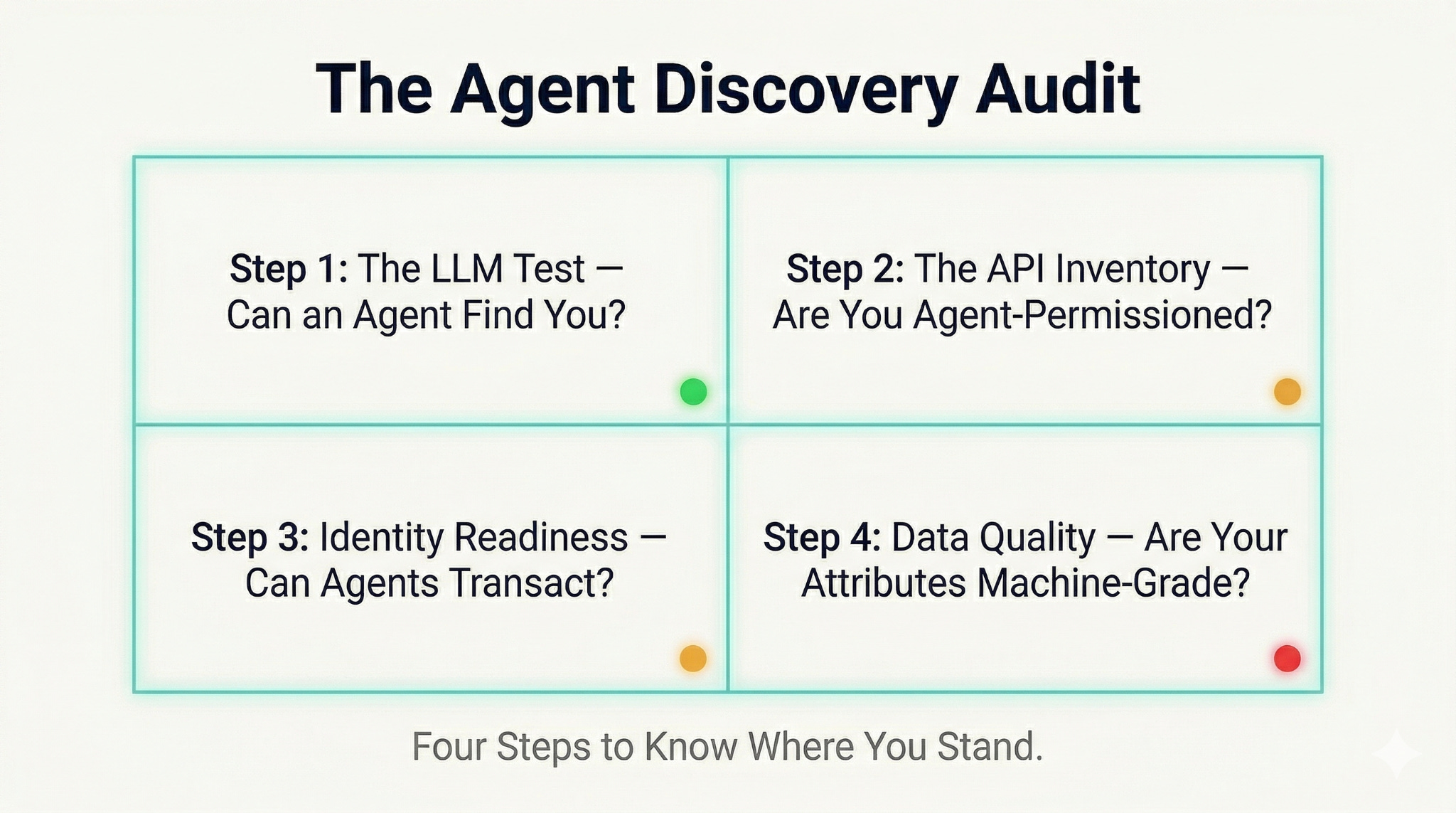
Step 1: The LLM Test: Can an Agent Find You?
Start here, because it costs nothing and reveals almost everything.
Ask a general-purpose LLM ( Gemini, ChatGPT, Claude, your choice) to find and describe your top 10 SKUs without giving it your URL. Ask it to tell you where to buy them, what the key attributes are, and what the current price is. Treat the output as a data quality mirror, not a novelty experiment.
What you’ll typically find falls into three categories.
Invisibility: the LLM can’t confidently identify your products and defaults to competitors or generic descriptions. This means your product data has low presence in machine-readable, publicly accessible formats.
Inaccuracy: the LLM finds something, but the attributes are wrong - outdated specifications, incorrect pricing, missing variants. This means your structured data exists but isn’t being maintained.
Reasonable accuracy: the LLM returns something close to correct. This is your baseline to build from.
What this test is actually measuring is the downstream effect of your structured data markup (schema.org implementation), the completeness of your product catalogue in formats that crawlers and APIs can parse, and whether your digital presence is designed for machines as well as humans. Most retailers have built for the latter. Very few have actively thought about the former.
In my experience, the response most common among leadership teams when they run this test is surprise- not at being invisible, but at being inaccurate. They assumed “we’re online, therefore we’re findable.” What they discover is that being findable for a human and being findable for an agent are two entirely different standards.
Step 2: The API Inventory: Are You Agent-Permissioned?
Being discoverable is necessary but not sufficient. An agent that can find your products also needs to be able to query them programmatically- in real time, at scale, without being blocked by rate limits or returning HTML that a human has to interpret.
The question to ask your technology team is specific: Can an authenticated third-party agent query your product catalogue and receive structured, real-time data, including availability, pricing, and variants- in a machine-readable format?
If the answer involves phrases like “we’d have to build that” or “it’s available through our website scraping,” you are not agent-permissioned.
Think about what this means in practice.
Product discovery is already happening at scale outside your owned channels. Consumers are learning about products, comparing options, and forming purchase intent in places your CRM has never seen and your analytics will never capture.
When an AI agent eventually acts on that intent (querying for real-time availability and price before completing a transaction), it will need an API to talk to. If you don’t have one that’s designed for that interaction, the agent routes to a competitor who does.
The checklist here is straightforward:
Is your product API publicly documented?
Does it return structured data or HTML?
Does it include real-time inventory signals?
Can it handle the query volume of programmatic access without throttling?
These are not complex engineering problems but they require your focus and attention.
Step 3: The Identity Readiness Check: Can Agents Transact on Your Platform?
This is where the 26% checkout trust gap becomes a design brief. Consumers don’t trust AI agents with their wallets, at least not yet. The answer isn’t better marketing. It’s Trusted Agent Protocols: the tokenisation and delegated authentication infrastructure that allows an agent to complete a transaction without the consumer feeling they’ve handed over their raw financial credentials to a black box.
The practical audit questions here are:
Does your checkout infrastructure support tokenised payment flows that could be initiated by a non-human agent?
Can a third-party system authenticate against your platform and complete a purchase within a defined permission scope, without requiring a human to be present at every step?
If your checkout is designed exclusively around a human filling in a form, the short answer is that you are not ready.
The work to build these trusted agent protocols is already gathering speed. Google’s Universal Commerce Protocol (UCP) is an open-source standard is being built exactly for this.
Protocols like UCP establish a common language which enables seamless commerce journeys between consumer surfaces, businesses, and payment providers. Further compatibility with Agent Payments Protocol (AP2), Agent2Agent (A2A), and the Model Context Protocol (MCP) is the key.
Google’s full protocol documentation is linked here
Step 4 : The Data Quality Scorecard: Are Your Attributes Machine-Grade?
The last step is the most foundational and frankly, the one that takes the longest to fix.
There is a critical difference between product data that is “good enough for a human” and product data that is “good enough for an agent.“
Human shoppers can look at an image and understand context. By nature, human’s infer. We read a vague description and fill in the gaps from experience.
Agents don’t infer. They parse explicit, structured attributes and make decisions based on what is actually present in the data, not what a reasonable person might assume.
So, here is what a machine-grade product data looks like in practice:
Every attribute is explicit and consistent (not “available in multiple colours” but “Colour: Navy Blue, Forest Green, Slate Grey”).
Taxonomy is standardised across your catalogue
Variant logic is resolved at SKU level, not parent product level.
Pricing and inventory are real-time, not batch-updated.
An agent querying a specific size and colour needs to know availability for that specific combination, not the parent product.
However, what I’ve seen so far across multiple customer engagements is that this is where the most significant gaps live and where the investment pays back beyond agentic commerce.
Clean, structured, machine-grade product data doesn’t just serve agents. It improves search ranking, personalisation accuracy, and feed quality across every channel. Here is a wonderful reference article from Google which reiterates this point: For companies to succeed with agentic AI, they must shift from an incremental approach to a comprehensive data strategy that is ready for AI’s needs
This agentic commerce readiness audit is, in a practical sense, a forcing function for data governance work that should have been prioritised years ago.
Quick-Start Checklist: Here is what you can do now.
A comprehensive audit may take weeks to complete rigorously. However, you can start with these five actions immediately.
1. Run the LLM Test on your top 10 SKUs. Ask a general-purpose LLM to find and describe them without a URL. Log what it gets right, wrong, and what it can’t find. This is your baseline.
2. Audit your product API documentation. Is it publicly accessible? Does it return structured data? Does it cover real-time inventory? If your technology team says “we don’t have one,” that is your first priority.
3. Map your checkout flow against delegated authentication requirements. Where are the gaps for agent-mediated transactions? Flag this for your payments and identity infrastructure owners.This is a 2026 roadmap item, not a 2028 one.
4. Assign a data quality owner for agent-readiness. This is a Data & AI problem, not a marketing problem. It needs an owner with the authority to enforce attribute standards across the catalogue.
5. Review your highest-volume SKUs for attribute completeness at the variant level. Start with your top 100. The gaps you find there will be representative of the catalogue-wide problem and fixing them first gets you the highest agent-discoverability return for the least effort.
The Agent Doesn’t Care About Your Brand Story
The retailers investing in agent-ready infrastructure today aren’t doing it because they have a mandate from the board or because a vendor sold them a roadmap. They’re doing it because they understand something fundamental about Agentic Commerce:
The next competitive advantage isn’t a better app, a more immersive loyalty programme, or a sharper campaign. It’s being discoverable, transactable, and trustworthy to a customer who will never visit your website.
The Agentic Gap is real. Whether you’ll close it on your own terms, or discover it when an agent routes to a competitor instead, is to be seen.
And a question for you: have you run the LLM Test on your top SKUs yet? What did you find? Drop it in the comments. I’d genuinely like to know what readers are seeing in their own markets.